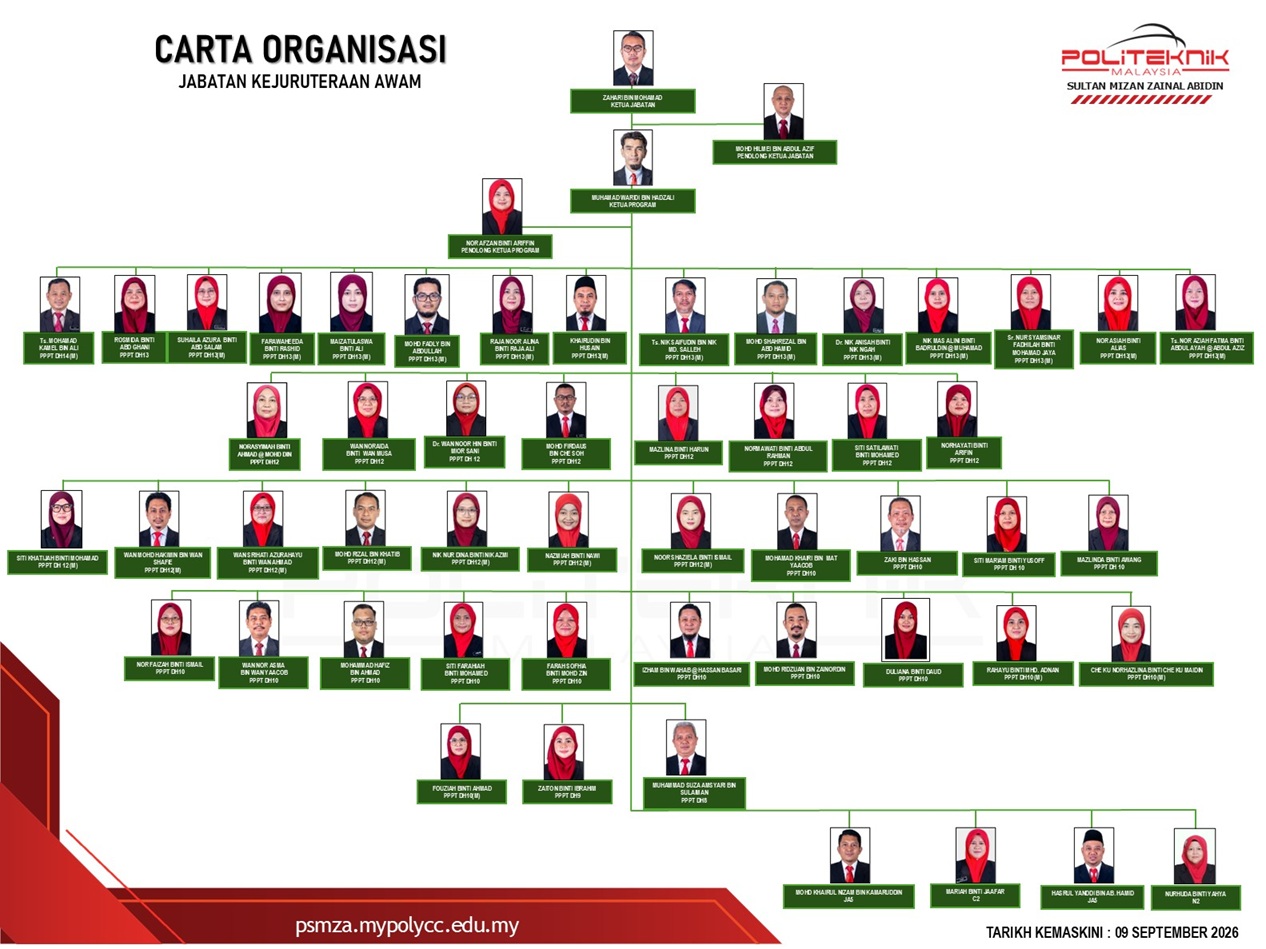
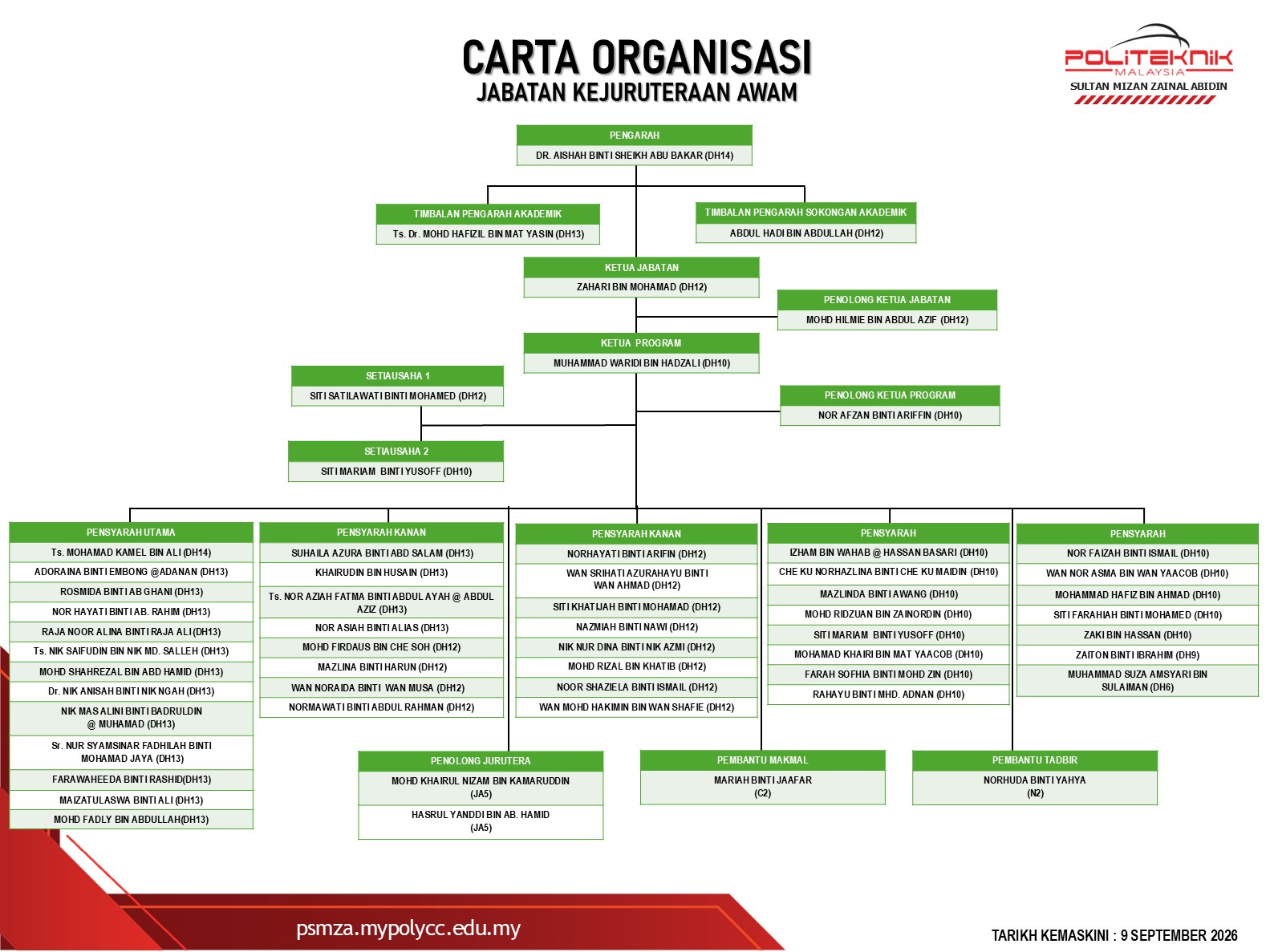
Jabatan Kejuruteraan Awam PSMZA ditubuhkan pada tahun 2001 dan diketuai oleh En. Zahari b. Mohamad selaku Ketua Jabatan. Bilangan pensyarah ialah seramai 52 orang dan 2 orang staf sokongan.Jumlah pelajar terkini ialah seramai 870 orang. JKA menawarkan satu program iaitu Diploma Kejuruteraan Awam.
Welcome to the Department of Civil Engineering (JKA)
The Department of Civil Engineering at Polytechnic Sultan Mizan Zainal Abidin is a hub of technical excellence, dedicated to shaping the future of the nation’s infrastructure. The department is currently led by our Head of Department, Zahari Bin Mohamad, and is supported by our Heads of Programme:
- Muhamad Waridi Bin Hadzali: Head of Programme Diploma in Civil Engineering
Our department is powered by a dedicated team of 50 academic staff and 4 support personnel, all committed to providing a high-quality Technical and Vocational Education and Training (TVET) experience.
Academic Excellence
We offer industry-relevant programs designed to meet the demands of the modern construction and engineering sectors:
- Diploma in Civil Engineering
To ensure our graduates are recognized globally, all programs are fully accredited by the Engineering Technology Accreditation Council (ETAC). This accreditation guarantees that our curriculum, facilities, and teaching methods align with both national standards and international engineering benchmarks.
Vision, Mission & Educational Philosophy
In line with the Department of Polytechnic and Community College Education (JPPKK), we strive:
Visions:
To be the Leading – Edge TVET institution.
Menjadi institusi TVET yang terkehadapan dan terunggul.
Mission:
- To provide wide access to quality and recognised TVET programmes.
Menyediakan akses luas kepada program TVET yang berkualiti dan diiktiraf.
- To empower communities through lifelong learning.
Memperkasa komuniti melalui pembelajaran sepanjang hayat.
- To develop holistic, entrepreneurial and balanced graduates and
Melahirkan graduan yang holistik, berjiwa usahawan, dan seimbang.
- To capitalise on smart partnership with stakeholders.
Memanfaatkan kerjasama pintar dengan rakan industri.
To bridge the gap between the classroom and the construction site, we implement a rigorous framework of Programme Educational Outcomes (PEOs) and Programme Learning Outcomes (PLOs). These are specifically designed to produce graduates who are not only technically proficient but also innovative, ethical, and ready to lead in the global engineering landscape.
PROGRAMME EDUCATIONAL OBJECTIVES (PEO) VERSION 2019
The Diploma in Civil Engineering programme shall produce semi-professionals who
are:
PEO1: Working in the field of civil engineering
PEO2: Lead or a team member to support their role in industries
PEO3: Engaged in activities to enhance knowledge or starting/embark their own enterprise
PEO4: Fulfil professional and communities’ responsibilities, conforming to ethical and environmental values
PROGRAMME LEARNING OUTCOMES (PLO) VERSION 2019
Upon completion of the programme, students should be able to:
PLO1: apply knowledge of applied mathematics, applied science, engineering fundamentals and an engineering specialisation as specified in DK1 to DK4 respectively to wide practical procedures and practices
PLO2: identify and analyse well-defined engineering problems reaching substantiated conclusions using codified methods of analysis specific to their field of activity (DK1 to DK4)
PLO3: design solutions for well-defined technical problems and assist with the design of systems, components or processes to meet specified needs with appropriate consideration for public health and safety, cultural, societal, and environmental considerations (DK5)
PLO4: conduct investigations of well-defined problems; locate and search relevant codes and catalogues, conduct standard tests and measurements
PLO5: apply appropriate techniques, resources, and modern engineering and IT tools to well-defined engineering problems, with an awareness of the limitations (DK6)
PLO6: demonstrate knowledge of the societal, health, safety, legal and cultural issues and the consequent responsibilities relevant to engineering technician practice and solutions to well-defined engineering problems (DK7)
PLO7: understand and evaluate the sustainability and impact of engineering technician work in the solution of well-defined engineering problems in societal and environmental contexts (DK7)
PLO8: understand and commit to professional ethics and responsibilities and norms of technician practice
PLO9: function effectively as an individual, and as a member in diverse technical teams
PLO10: communicate effectively on well-defined engineering activities with the engineering community and with society at large, by being able to comprehend the work of others, document their own work, and give and receive clear instructions
PLO11: demonstrate knowledge and understanding of engineering management principles and apply these to one’s own work, as a member or leader in a technical team and to manage projects in multidisciplinary environments
PLO12: recognise the need for, and have the ability to engage in independent updating in the context of specialised technical knowledge
PROGRAMME EDUCATIONAL OBJECTIVES (PEO) VERSION 2024
The Diploma in Civil Engineering programme shall produce semi-professionals who are:
PEO1: Working in the related field of Civil Engineering
PEO2: Lead or a team member in fulfilling their roles in industries
PEO3: Engaged in activities to enhance knowledge or embark their own enterprise
PEO4: Fulfil professional and communities’ responsibilities, conforming to ethical and environmental values
PROGRAMME LEARNING OUTCOMES (PLO) VERSION 2024
Upon completion of the programme, students should be able to:
PLO1: apply knowledge of applied mathematics, applied science, computing and engineering fundamentals and an engineering specialisation as specified in DK1 to DK4 respectively to wide practical procedures and practices.
PLO2: identify and analyse well defined engineering problems reaching substantiated conclusions using codified methods of analysis specific to their field of activity (DK1 to DK4).
PLO3: design solutions for well-defined technical problems and assist with the design of systems, components, or processes to meet specified needs with appropriate consideration for public health and safety as well as, cultural, societal, and environmental considerations as required (DK5).
PLO4: conduct investigations of well-defined problems; locate and search relevant codes and catalogues, conduct standard tests and measurements (DK8).
PLO5: apply appropriate techniques, resources, and modern engineering computing and IT tools to well defined engineering problems, with an awareness of the limitations (DK2 and DK6).
PLO6: consider sustainable development impacts* to: society, the economy, sustainability, health and safety, legal frameworks, and the environment, in solving well-defined engineering problems (DK1, DK5, and DK7).
PLO7: understand and commit to professional ethics and responsibilities and norms of technician practice and including compliance with national and international laws. Demonstrate an understanding of the need for diversity and inclusion (DK9).
PLO8: function effectively as an individual, and as a member in diverse and inclusive teams in multi-disciplinary, face to face, remote and distributed settings (DK9).
PLO9: communicate effectively and inclusively on well-defined engineering activities with the engineering community and with society at large, by being able to comprehend the work of others, document their own work, and give and receive clear instructions.
PLO10: demonstrate awareness of engineering management principles as a member or leader in a technical team and to manage projects in multidisciplinary environments.
PLO11: recognize the need for and have the ability for i) independent and lifelong learning and ii) critical thinking in the face of specialised technical knowledge (DK8).